by Dave Presby
I. Building a Base II. Warming Up III. The Race
IV: Crossing a Finish Line
“GO, DAVE! GO!”, I could hear Dad roaring. “LET’S GO, DAVE!”
As I furiously approached the finish, my gaze settled on the red digits displayed on the electronic timing clock… counting up… 1:26:37… 38… 39… 40… I dug down for the final burst… 44… 45… 46…
“ALL RIGHT, DAVE! WAY TO GO!”
I crossed the timing mat under the finish line, just as the clock read 1:26:48. As I stopped to collect my breath, as well as a cup of water and a finisher’s medal from the volunteer, Dad nudged through the crowd and came up beside me, patting me on the back.
“Well done, Dave. GREAT race! That’s an excellent time on that course.”
I bent over and braced myself with my hands on my knees, trying to catch my breath.
“You were all alone out there in no-man’s land,” he continued. “The third-place finisher came in around an hour and twenty-two minutes.”
“Yeah, he dropped me early on the first hill,” I blurted out between gasps. “On another day I may have tried to stay with him for a bit… I didn’t want to wear myself out early on.”
“Yeah, you want to be fresh for October,” he agreed.
I was mostly satisfied with my effort. However, a quick look at my splits reminded me of my pesky hamstring, as well as the missed opportunity to make up additional time on the long downhill spanning the eighth and ninth mile. By my estimation, I probably left the better part of sixty to ninety seconds out on the course, which didn’t make me very happy. But I quickly quelled my nagging gripe, heeding Dad’s reminder that my primary focus was my upcoming marathon in October. In that regard, the day’s performance turned out to be an extremely valuable complement to my training, and he was well aware of how important that was.
For the next forty-five minutes, we wandered around the baseball field, cheering for runners as they broke out of the forest and dashed across the field to the finish. I caught up with the top three finishers and congratulated them on their performances. I headed over to the refreshments table and filled up on bananas and oatmeal bagels smeared with crunchy peanut butter. For a few moments, I chatted with Gary Allen, the race director of the Mount Desert Island Marathon, and one of only a select few to run a sub three-hour marathon in five straight decades. Eventually, the awards were handed out. When my name was called, Dad clapped and cheered enthusiastically as I collected my first-place award for the male 40-49 age group.
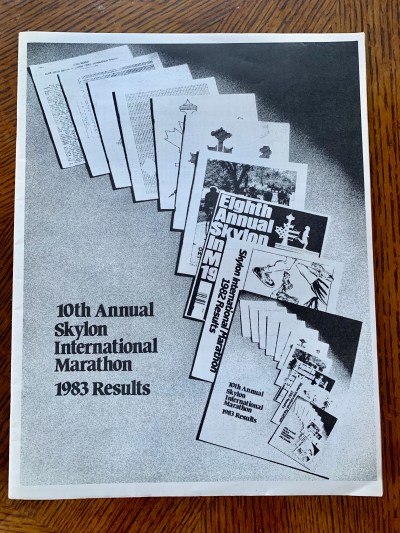
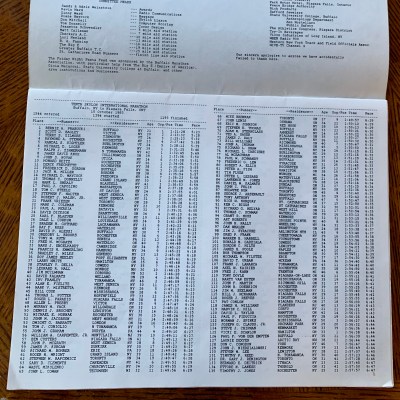
I always treasure every race that Dad can attend, but every shared experience is often accompanied by feelings of regret, as I ponder and think back to what an accomplished runner he was many years ago. There was a stretch during the late ‘70s and early ‘80s when he racked up a handful of impressive performances… the highlight being his 2:47:47 finish at the 1983 Skylon International Marathon in Niagara Falls. As young as I was, I never had a chance to witness and appreciate his accomplishments in person.
Instead, the most vivid memory I have is back in the house in Victor where I grew up. I can still see Dad, sitting on the carpeted stairs in the front entryway lacing up his running shoes. He’s wearing red shorts and a light blue cotton t-shirt from one of his older races. He gets up and announces that he’s going out for a run… to anybody who may be within earshot. He heads outside, closing the front door behind him, and parks himself at the top of the driveway where he stretches for a few minutes. Finally, he strolls down to the road, pauses to start his watch by our mailbox… and off he goes down the street. On some days, I’d stand by the large bay window in our living room, watching him get smaller and smaller, until he finally disappeared around the bend, swallowed up by the neighborhood.
Unfortunately, the few memories I have of his races are incomplete snippets… brief, fuzzy images that play through my mind out of order with no rhyme or reason… like a series of outtakes from multiple movies, left on the cutting room floor. It wasn’t until I’d run cross country for several years that I was truly able to appreciate his own accomplishments.
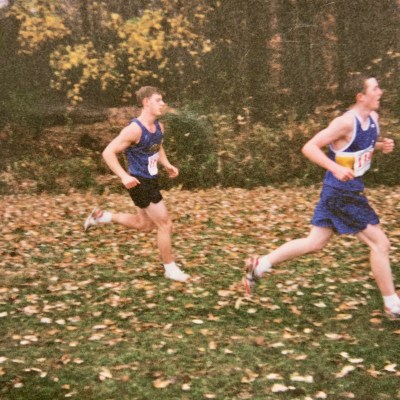
It saddens me that we didn’t have a chance to compete together at a higher level for an extended period of time. As my sister and I grew up, Dad continued to race and train, but not at the intensity that he maintained during his peak years. Instead, he selflessly turned his focus towards the two children he loved, helping us navigate our way through junior high and high school cross country for the Victor Blue Devils.
My sister turned out to be an elite performer in high school, garnering numerous accolades at the local and Sectional level. On the other hand, I was merely a mediocre plodder, managing to crack the varsity top seven in just a single race during my entire high school career. And yet, Dad always placed just as much importance on my races as my sister’s. He and Mom attended virtually every one of our meets, earning the reputation as the loudest, most enthusiastic parents on the Victor cross country team.
For a relatively short period during my high school and college years, Dad and I ran several road races together. On Thanksgiving, there was a local 5-mile Turkey Trot that became a family tradition for several years. During the summer before my senior year at Victor, Dad and I ran the Phelps Sauerkraut 20K, which is the oldest road race in the Finger Lakes. By that point, I was already clocking faster times.
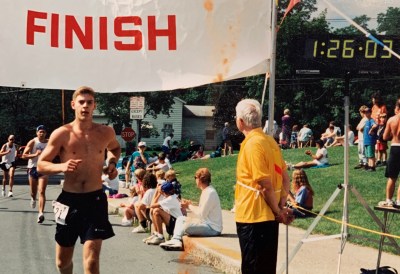
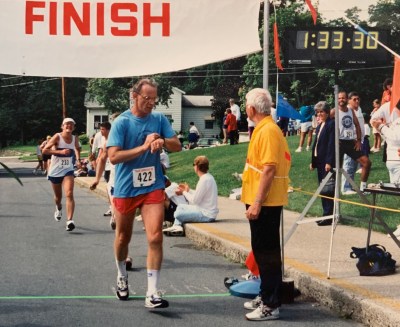
I wish I could say that I had finally caught up to Dad, but that would be stretching the truth. I have yet to catch him. While I’ve managed to become a fairly decent runner in my own right, I’ve never approached any of his personal bests at any distance. By the time we toed the starting line together, I had already pulled ahead, not because he didn’t have the ability to train hard and continue competing at a high level. But he realized when you have a job and obligations to your family, you have to pace yourself and be smart as you press onward.
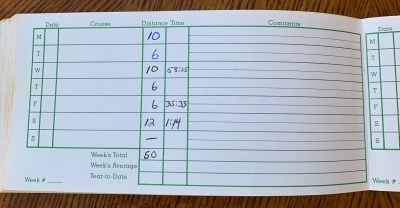
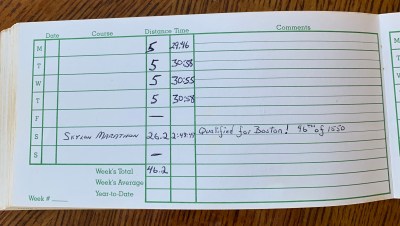
I recently happened upon the training log that he kept as he prepared for the 1983 Skylon Marathon. As most runners know, the three week taper before a marathon is considered a staple of race preparation, as both the mileage and intensity are gradually reduced to help the body recuperate from heavy training, build up glycogen stores, and prepare for the race. When I examined the three weeks of training preceding Dad’s marathon, what I saw recorded in the pages of his log absolutely astounded me.
On race week, Dad went out for a five-mile run each day from Monday through Thursday, while taking Friday off. Certainly not high mileage by any means, but then I noticed the times written next to the distance… 29:46 on Monday, 30:38 on Tuesday, 30:55 on Wednesday, and 30:58 on Thursday. On four consecutive days during race week, Dad had clocked a five-mile run at a 5:57-6:08 pace.
I flipped to the previous page and scanned the handful of workouts from the week before. What I saw scrawled in pen for each day of that week defied all training logic…. a twenty-miler on Tuesday at a 6:27 pace, a six-miler on Thursday at 5:45 pace, a seven-miler on Friday at 6:06 pace, a ten-miler on Saturday at 5:55 pace, and then another seven-miler on Sunday at 6:08 pace. The trend continued during the previous week… a ten-miler on Wednesday at 5:49 pace, a six-miler on Saturday at 5:57 pace, and a twelve-miler on Sunday at 6:10 pace.

After managing to collect my jaw off the table, I asked Dad how he possibly managed to train at this intensity for the three weeks leading up to a marathon.
“I never wasted a workout,” he responded. “I got to the point where I could basically spit out mile after mile at a six-minute pace in my sleep. That was just my most comfortable pace.”
“But… what about a taper?” I countered. “Weren’t you afraid of wearing yourself out by race day?”
“David, I had no idea what tapering was,” he said. “I was just trying to run a fast marathon.”
Naturally, I was curious how he stayed hydrated during his twenty-mile runs.
“Oh, I never drank water during my long runs,” he said. “I just drank some water before I started and then again after I finished.”
My next question… how much water did he drink during his race.
“Oh… probably one… or maybe two small cups of water for the whole race. Gosh, I can’t remember. It was almost forty years ago.”
The mere mention of long, slow distance training nearly drove him off the deep end.
“For goodness sakes, David,” he barked. “My goal wasn’t to run a marathon at an 8:00 pace, so why on earth would I run my twenty-milers that slowly!?”
During the past twenty-five years, I’ve read pages and pages of research about training philosophy and theory that espoused the use of long, slow mileage as a vital part of a successful training plan. And yet, I had no answer for Dad. I was speechless.
“I had no time for that LSD garbage,” he continued. “My goal was to run at a six-minute pace during every mile of every run.”
I had nothing left to say, instead just staring at him blankly… my mouth slightly agape.
“Well it worked, didn’t it!? I knew of no other way,” he said. “It’s just what I did.”
While the period of time during which Dad trained and performed at peak level was relatively short, the hard work, sweat, perseverance, and pain he endured during his brief stint of success hardened him and helped him achieve in the areas of life that matter most.
As a father, the dedication and support that he showed towards my sister and I during our cross country careers was nothing short of legendary. After high school, both of us attended separate colleges in central Ohio, about six hours away from home. And yet, both Mom and Dad still made the effort to travel to as many of our Saturday meets as was realistically possible.
Dad’s selfless dedication can be epitomized by a trip he made during my junior year at Muskingum College to watch one of my races. The invitational was being held at a golf course just about an hour north of campus, which still meant a six-hour drive from home. Normally, Mom and Dad would book a hotel if the drive was more than three hours, but Dad had a prior obligation scheduled for Friday night. With my race set to go off at 10:00 AM, it looked doubtful that anybody from the family would be coming to watch. This simply meant that I’d call home later in the day to fill in Mom and Dad about my race, which was perfectly fine with me.
But apparently, a phone call wasn’t going to cut it for Dad. Instead, he set his alarm for 2:30 AM Saturday morning, jumped in the car at 3:00, and drove the six hours to the golf course where the meet was being held, arriving just after 9:00. When I returned from my warm-up, I noticed him milling about our team’s tent, chatting with a few other parents. I was speechless. When he saw me returning with the rest of the team, he strolled over to greet me.
“David,” he exclaimed. “I came to watch you run today!”
My race went off at 10:00 AM as scheduled, and I ran a 32:27 on the rolling five-mile course… mediocre at best for a college time. As I crossed the finish line, I caught sight of him waiting for me near the end of the chute. I grabbed a cup of water and headed over to meet him.
“Nice job. You looked pretty good out there. What was your time?”
“Oh… somewhere around 32:27, I think?”
“Just around a 6:30 pace… Nothing wrong with that.”
He stuck around long enough to watch the girls race. Then just as quickly as he’d arrived, he was gone… back on the road for six more hours in the car, arriving home just in time for dinner. With two church services to prepare for the next day, I’m fairly certain that he probably had at least a dozen items on his “to-do” list that were more pressing. Instead, he chose to spend twelve hours in the car to watch his son run for just over half an hour with a bunch of other college kids, many of whom were substantially faster.
That was Dad. He knew no other way. It’s just what he did.
And then there was Mom, who lay helpless and bedridden, gradually wasting away for the final month of her life, as the tumor metastasizing uncontrollably just beneath her skull ate her alive. During the early stages of her illness, the cancer chipped away at her speech, robbing her of the ability to express to Dad her thoughts, needs, and feelings. This is how he eventually determined that something was terribly wrong, even weeks before she had the MRI and ultimately received the unthinkable diagnosis.
Every night at dinner, she’d spot something on the far side of the table that she wanted.
“I need… I need…,” she’d begin. “I need…,”
And then… uncomfortable silence.
More often than not, the name of the item eluded her, as she’d shake her hands emphatically in frustration, unable to lend her voice to simple objects commonly found at the dinner table… such as salt and pepper, ketchup, or potatoes. Thanks to the steadily growing mass inside of her head, the language centers in her brain just weren’t making the connections to the areas responsible for speech production. She could hear the words “salt”, “ketchup”, and “potatoes” ringing out in her mind as clearly as a bell, but she couldn’t translate those thoughts into spoken word. “Broca’s aphasia”, was the term for the impairment, in which language comprehension remains relatively intact, while the production of words and sentences is greatly compromised. Cruel irony indeed for an intelligent, thoughtfully-spoken woman with a Master’s degree, who’d taken great pride in teaching language and reading to junior high students for so many years.
As the months wore on, she lost her ability to perform the every day occupational functions most of us take for granted, such as dressing and bathing. One day, Dad heard the water running in the bathroom at an unusual time during the afternoon. When he went upstairs to investigate, he found Mom standing in the tub still wearing her clothes, a bar of soap in her hand. She was even wearing her shoes. She knew she wanted to take a shower, but she wasn’t quite sure how to go about it, or what to do next. While it was both physically and emotionally exhausting for Dad to continuously adjust to the unpredictable circumstances that accompanied Mom’s declining condition, he never asked for a timeout or a sick day to collect himself. He simply pressed on, doing his best to help her overcome every curve-ball lobbed her way by the expanding, toxic mass that was gradually sucking her life away.
As her condition worsened, I was having an increasingly difficult time sorting out my feelings and keeping my emotions under wraps. Unlike Dad, who was present all along to witness her gradual decline, I was only able to visit once every two to three weekends. During the last six months of her life, the amount she regressed between each of my visits was alarming.
I remember one day at lunchtime when Dad had been warming up a large container of leftover spaghetti and sauce in the microwave. As the buzzer sounded, Mom simply opened up the door and reached inside, grabbing a huge handful of steaming hot pasta with her bare hands, which she promptly dropped all over the counter, crying out in pain.
“Be careful, Honey,” Dad said, as he stepped in calmly, gently leading her over to the kitchen sink, where he helped her clean up. “Remember to use a hot pad when you take food out of the microwave.”
At that moment, I should have been helping out by cleaning up the messy pile of pasta and sauce that was scattered all over the counter and floor. Instead, I just stood there completely dumbfounded, and I could feel the anger welling up from deep within.
I dealt with a lot of anger during Mom’s rapid decline. I was angry that I would never have the opportunity to relate to her as an adult. I was angry that my nephew would never know his grandmother. I was livid that my sister would not have the opportunity to share the joys, trials, and tribulations of raising her child with her own mother.
My anger certainly wasn’t limited to the confines of our tightly knit family unit. Every day, there were dozens all around me who were smoking, eating junk food, and abusing their bodies on a regular basis. It was infuriating to me that these people appeared to be taking their health for granted, content to continue living a reckless, destructive lifestyle, completely unappreciative of the basic abilities they enjoyed each day.
Mom, on the other hand, had lived her life by the book. She went for a brisk walk five days a week to get her heart moving. She always made the effort to eat her fruits and vegetables. She had never touched a cigarette or a drop of alcohol in her life. And yet, her reward for clean living was an aggressive brain tumor with fifteen-month survival rate.
While I’m painfully ashamed to admit it, I even found myself growing angry at the helpless, incompetent imposter in my parents’ kitchen that afternoon. I was incensed that this intruder apparently didn’t know enough to use an oven mitt to remove a piping hot container of pasta from the microwave, and then wait for it to cool down before dishing the contents out onto a plate with a spoon.
Who are you? What the hell have you done with my mom?
Of course, I was quick to collect myself and come to grips with the fact she was not an imposter. She was my mother, she was incredibly ill, and she simply needed all of the love and support we had to offer. Along with the constant heartbreak and sadness, the feelings of guilt ate away at me daily… guilt for my misplaced anger… guilt for wondering if I was visiting enough. I even felt guilt for my part in arguments that I’d had with Mom years ago.
Dad, on the other hand, was rock solid in the face of the adversity that was waiting for him around every corner of the journey. From the moment Mom was diagnosed, he made it clear by his actions that he would not relinquish any part of her care to a third party for any more than a few hours at a time. Occasionally, a friend or family member would come to the house and spell him if he had a work-related obligation or engagement. But any assistance he received was only temporary. There was no question as to who was in charge on a daily basis. While he was obviously heartbroken and terrified, he realized that his feelings were secondary in comparison to the overwhelming fear, loneliness, despair that she must have been experiencing. He certainly had his private moments when the gravity of the situation overwhelmed him and he broke down. But when in Mom’s presence, he remained brave, focused, and strong.
That was Dad. He knew no other way. It’s just what he did.
Mom reached her final moments in the early hours of a chilly October morning, with Dad parked firmly at her bedside, holding her hand and comforting her. He told her how much we all loved her. He held a large photograph of their four-month old grandson by her side. As she approached the finish line, he held her close, letting her know that everything was going to be OK.
Even after she’d passed, he stayed by her side, refusing to abandon her. He eventually dozed off in the recliner by the hospital bed that had been brought into the front living room, serving as her home for the past month. After a few hours, dawn broke as the early morning sunshine began to gradually filter through the shades of the front room, hinting at the promise of a new day.
When Dad stirred and awoke, he sat quietly for a few minutes, collecting his thoughts. Finally, he rose out of his seat, headed to the kitchen, and brewed a half pot of coffee before starting to make all of the inevitable phone calls. I remember asking him how he actually found the strength to pull himself out of that recliner, after what he’d just endured.
“What else was I supposed to do?” he asked, shrugging his shoulders helplessly. “There was a lot of work to be done that day. Life goes on, you know.”
For over a year, he had selflessly given everything he had, every ounce of energy, to the love of his life. Never once did he entertain the thought of shipping her off to spend her final days in a hospital or in surroundings that were foreign to her. Watching a loved one break down, disintegrate, and slip away before your eyes is an utterly agonizing ordeal. As the sun set on each day, he was completely spent, but he knew that tapering was not an option. He kept up the intensity, and he kept pressing onward.
That’s Dad. He knows no other way. It’s just what he does.
Up Next

 StudioCrowlogue 26.2
3 thoughts on “Training Yourself…Racing for Others (4)”