by Dave Presby
I. Building a Base II. Warming Up
III. The Race IV. Crossing a Finish Line V. Cooling Down
VI. Beyond the Finish Line
For Dad, there has been plenty of life beyond the finish line. He has since remarried and is now retired from a lifelong career as a Presbyterian minister. He and his wife Carol live on ten acres out in the country in the Susquehanna River valley high up in the hills just outside of Bainbridge, New York. His summers are spent keeping varmints out of his vegetable garden and feeding the almost one hundred koi fish in the pond on their property. During winters, he keeps busy pitching logs into the wood stove, watching football, and working on the model railroad layout in his man-cave above the garage.
The newest source of pride and joy in Dad’s life is white and fluffy with floppy ears, weighing barely as much as a toaster. Earlier this summer, he and Carol welcomed a two-year old Schnoodle named Tucker into their home. Up to that point, Dad had never owned a dog, instead playing father to a parade of various cats over the years, each very charming, endearing, and unique in their own right. Two years ago, their five-year old cat Tony died unexpectedly from liver complications. Tony was a sweet feline with an enormous personality, and his sudden passing left a giant void in their hearts. At that point, Dad swore up and down that he was through with small, furry creatures.
However, almost a year later, he learned that my uncle’s good friend was moving into an assisted living complex and couldn’t take her dog along. He and Carol happened to meet Tucker several weeks later during a visit, and they were both immediately smitten. It took all of two minutes for them to offer to adopt the pint-sized ball of fluff.
I have to admit I was very skeptical, as I was having a hard time imagining Dad taking in a two-year old dog at the young age of seventy. But Tucker came with several built in advantages, the most obvious being that he’s a fraction of the size of any cat Dad’s ever owned. One of the draws of a cat for Dad was the frequent lap time. Tucker certainly fits the bill in this regard, sometimes spending an entire afternoon curled up with Dad during a football game.
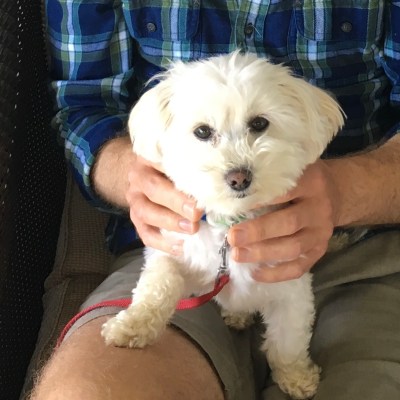
“I swear I can feel my blood pressure dropping whenever Tucker is sitting with me,” he says. “I can see why small dogs are sometimes prescribed for therapy.”
Of course, he’s quick to point out the other advantages of owning a portable canine.
“David, you wouldn’t believe it,” he exclaims enthusiastically. “When I take Tucker out for his morning constitutional, his poops are so small I don’t even have to clean them up. They just disappear into the yard!”
In this case, the literal interpretation is true. It’s the little things in life that matter most.
Most importantly, Tucker is one of the sweetest, friendliest, well-mannered dogs I’ve ever met. Any nagging doubts were laid to rest when I finally met Tucker and witnessed first-hand Dad fussing and fawning over him, baby-talking him ad nauseam, and generally conducting himself and carrying on like a five-year old girl.
Aside from the regular exercise he gets during his walks with Tucker, Dad keeps himself active by attending a spin class several times a week and biking on the roads and trails of the Susquehanna River Valley. He’s also undertaken a handful of interesting challenges during the past several years, including a weekend snowshoeing workshop in the White Mountains of New Hampshire, as well as several trips up Mt. Katahdin in Maine’s Baxter State Park.
The most ambitious physical endeavor Dad’s ever attempted outside of running marathons occurred back in 2001, when he and one of his colleagues decided to enter the General Clinton Canoe Regatta, a 70-mile canoe race that travels along the Susquehanna River in the eastern part of New York State, starting in Cooperstown and finishing in Bainbridge.
I remember watching the start of the race from the south end of Otsego Lake. Off in the distance, an army of canoes approached like a tidal wave, eventually spilling into the mouth of the Susquehanna River where mass chaos ensued. It was nothing short of fascinating watching dozens of pairs in their boats, jockeying frantically for position as the race corridor narrowed down to a trickle.
The charge was lead by Serge Corbin, the Canadian marathon canoe racer who dominated the sport for well over three decades. I had no idea who Serge Corbin was until Dad signed up for the race, and made it his mission to research his primary competition. And then, in the days leading up to the race, it was nothing but Serge Corbin talk radio from Dad twenty-four hours a day.
“At the start of the race, keep an eye out for Serge Corbin,” Dad said repeatedly. “He’s been dominating this race for years.”
It was as if he expected that a lifetime’s worth of research on Serge Corbin would gain him an edge on his competition.
“You’ll know him when you see him,” Dad added. “He’s sure to be leading the pack early on. Be sure you pay close attention to his technique.”
This was vintage Dad, making it a point to completely immerse himself and absorb as much information as possible, whenever he tried his hand at something new.
After most of the field funneled into the mouth of the Susquehanna River, a few stragglers came along, paddling at a leisurely, yet steady pace, bringing up the rear… Dad and his partner included. At that point, Serge Corbin was probably already twenty miles down the river, but Dad wasn’t discouraged. After all was said and done, he managed to make it about fifty miles downstream before having to pull out due to his partner coming up lame with a bad shoulder.
I’m still not sure what prompted him to sign up for such a grueling endeavor. Mom was actually with us at that point. However, the months of chemo, radiation, and additional experimental treatments had proven ineffective. By then, Dad had pretty much lost any remaining sense of hope for her recovery, resigning himself to the fact that the finish line was in sight. I suspect that he was looking for an outlet or a challenge to get him out of the house on a somewhat regular basis, just enough to distract him from the heartbreak that was unfolding at home, if that was even remotely possible. If nothing else, I’d assume that spending a few hours breaking an honest sweat while surrounded by the beauty of nature is a good way to take a break from reality, if just for a short spell.
As for running, Dad still gets out for a slow shuffle once or twice a week, but he’s finding it difficult to make any progress. He may enter a race here or there, if he can string together more than a few runs over the period of several weeks.
In his own words, “My knees just aren’t what they used to be, and I’m probably carrying twenty-five pounds too many at the moment.”
He ran a 5K earlier in the fall, finishing the race in just under thirty-four minutes. He was so disgusted with his time that he gathered his belongings and began herding Carol to the car within minutes of crossing the finish line.
“Allen,” Carol protested. “Why don’t you at least go over to where the times are posted and see if you placed in your age group.”
Reluctantly, he made his way to one of the computer kiosks and entered his bib number in the search field. Lo and behold, he had placed first in the seventy-and-over age group.
“A small victory, but a victory nonetheless,” he admitted.
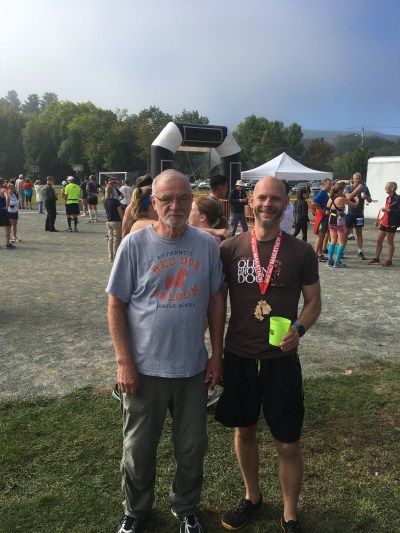
Most of his recent involvement in running has involved spectating and race support. Aside from showing up to cheer me on at a handful of my annual races, he’s spent the last several years closely following the progress of his two grandsons as they’ve steadily made their way up the ranks of their high school cross country team. A few weeks ago, he was thrilled to watch his oldest grandson Gabe run in the high school state meet in Hershey, Pennsylvania.
While he certainly amassed a handful of accomplishments quite during his running career, one of Dad’s biggest regrets is that he never got a chance to run the Boston Marathon. As can be seen in the pages of his running log, his banner finish at the Skylon Marathon in 1983 easily qualified him to compete, but he never actually entered the race the following year. For the longest time, I thought that he had passed due to an injury. I recently asked him about it again.
“No, I wasn’t injured,” he said. “If I recall, I had another work or family commitment scheduled. The trip just wouldn’t have worked out that year.”
Yet again, I was speechless. Qualifying for and competing in the Boston Marathon is the pinnacle for all who lace up their trainers on a daily basis. As usual, Dad put his family and other obligations first, passing on the opportunity of a lifetime.
This past spring, I finally ran a qualifying time with a large enough cushion in my age group to virtually guarantee entry. I quickly reserved a hotel room with two double beds near the finish line, thinking that at least one or two others from my running group would join me. As it turns out, many of my friends in my local running group are taking a year off from Boston or competing in other races. Of course, Dad made the comment that he’d love to go with me to enjoy the weekend and cheer me on.
“But David,” he stressed to me. “If any of your friends need a room at the last minute, I completely understand. But I’d love to claim that spare bed if you can’t find anybody else.”
I thought about what he said for all of ten seconds. At this point, none of my close friends are running in 2019. What’s more, I’d never offer that bed to another runner whom I barely know, leaving Dad stranded in the wind.
While he never participated himself, he’ll be just as happy to make the trip to Boston on Patriot’s Day this spring to watch and cheer me on, as I toe the starting line in Hopkinton for the very first time. After all Dad has done for me over the years, it would be great to deliver him a memorable race. But whether I run three hours or four hours, the most important part will be having him along for the ride.
The End

 StudioCrowlogue 26.2
One thought on “Training Yourself…Racing for Others (6)”